External web searches
Give your financial agents market memory.
SignalRoom tells agents what the market knew, why it mattered, how shocks transmitted, what happened in comparable states, and what in your portfolio was exposed.
A platform team creates a key. A research desk watches the rewind. The agent makes one context call.
In the accepted native temporal evaluation, adding SignalRoom increased task completion from 52% to 79%.
CONNECTED MARKET MEMORY18:05 UTC
01 / The catalystA chipmaker cuts its outlook.
One company’s guidance. Two paths through your book.
02 / TransmissionRepriced earnings expectationsPressure on comparable valuations
03 / Your exposureSector holdingsA read-through is a hypothesis. Price evidence can disagree.
THE DIFFERENCE
Not just what happened.
Why it reaches your portfolio.
Internal temporal evaluation
90 questions across 15 market episodes. Same model. Same questions. SignalRoom added as context infrastructure. These are internal evaluation results, not a universal quality score and not a FinSearchComp leaderboard result.
Task completion
52%79%
+27 percentage points
- Market path recall
- 32% → 58%
- Exposure reasoning
- 33% → 93%
- Transmission reasoning
- 33% → 69%
On questions both agents completed, path recall still improved. Overall answer lift partly reflects improved completion.
Read the methodology and full results. Search reduction is not a cost-saving claim; total estimated run cost increased.
Search tells an agent what exists now. SignalRoom lets it know what the market knew.
Different shocks. The same connected questions.
From company guidance to commodity disruptions and credit stress—not just central-bank decisions.
A chipmaker cuts its outlook. Who else is exposed?
Guidance → supplier demand → semiconductor holdings
Oil supply tightens. Where does the cost shock travel?
Supply shock → fuel costs → transport margins
A lender’s funding costs jump. What was already knowable?
Funding stress → refinancing conditions → credit exposure
Illustrative research questions, not reconstructed events or guaranteed coverage. Answers depend on ingested evidence; missing links remain unknown.
Set up in three steps
Keep the models, terminals, and data you already use. SignalRoom sits underneath as the point in time context layer. No billing in this version.
1
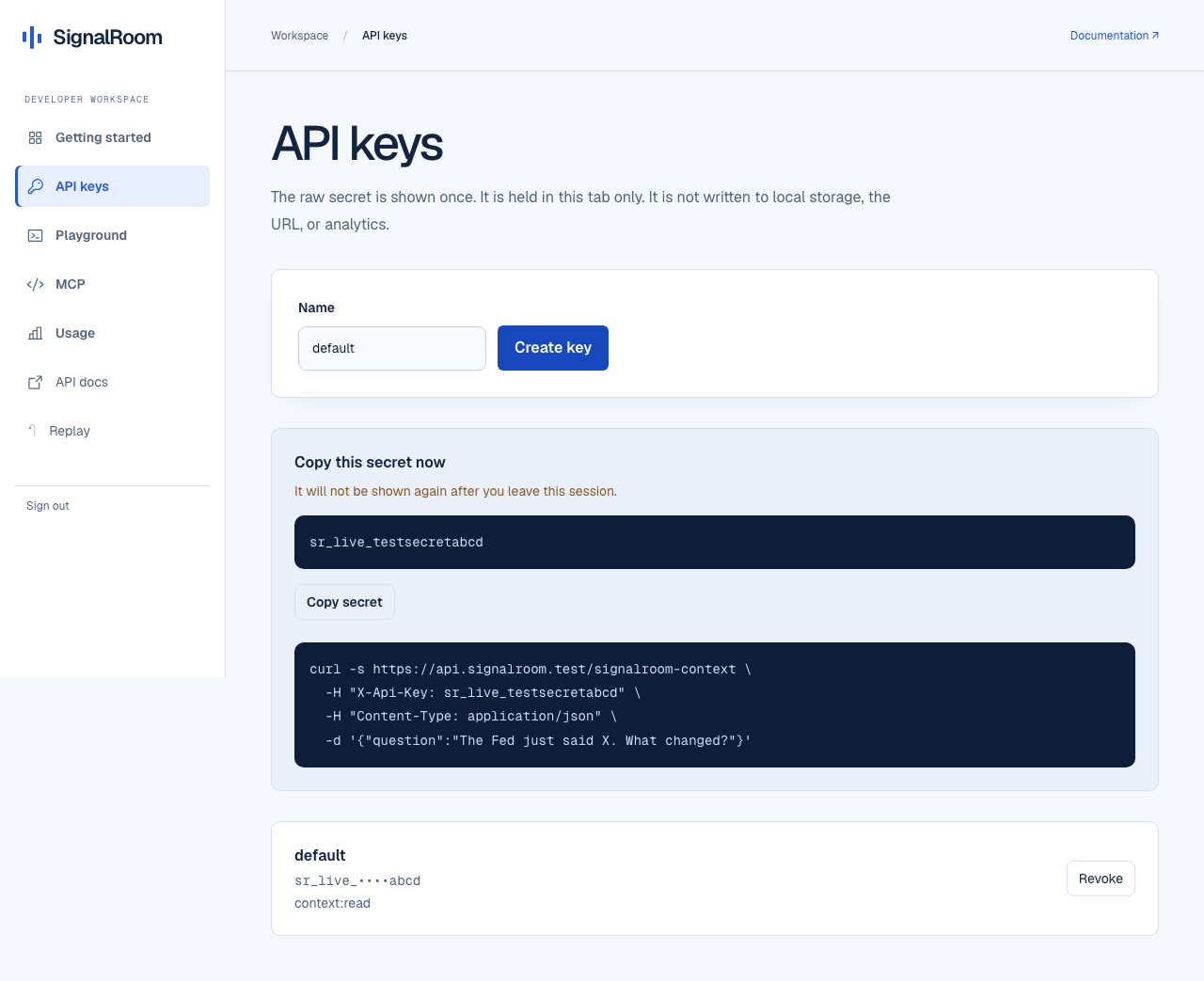
Create a context:read key
Desk
An operator signs in and issues a key. The secret is shown once.
Engineer
Self issued keys cannot mint admin, ingest, or overlay:write scopes.
2
Attach REST or MCP
Desk
Your agent platform team pastes the key into the existing agent runtime.
Engineer
POST /signalroom-context, or stdio MCP with SIGNALROOM_API_URL and SIGNALROOM_API_KEY.
3
Ask what was knowable at T
Desk
Watch the live rewind if you want the contract without writing code first.
Engineer
Pass a question, an as of time, and optional entities. Inspect drivers, transmission, analogues, and UNKNOWN.
curl
curl -s https://signalroom.fly.dev/signalroom-context \
  -H "X-Api-Key: sr_live_YOUR_KEY" \
  -H "Content-Type: application/json" \
  -d '{"question":"Oil supply was disrupted. Which industries face margin pressure?","as_of":"2024-09-18T18:00:00Z"}'
POST /signalroom-context
{
  "question": "NVIDIA revised its outlook. What changed for suppliers and semiconductor holdings?",
  "as_of": "2024-09-18T18:00:00Z",
  "entities": ["nvda", "tsm"],
  "include_analogues": true
}
Search finds facts. SignalRoom remembers state.
Search / RAG
- Finds what exists now
- Retrieves documents and snippets
- Makes the model reconstruct relationships each run
SignalRoom
- Reconstructs what was knowable at T
- Returns structured market state
- Preserves drivers, transmission, analogues, evidence and UNKNOWN states
- Can layer private portfolio context without contaminating the shared graph
What agents actually get

Point in time market memory
Before an earnings release or guidance revision, what was actually knowable? Reconstruct the state then, not today’s hindsight.

Drivers and transmission
Trace an oil-supply shock through input costs, margins, and exposed industries. Auditable paths; rank is a weight, not a probability.

Historical analogues
Compare a credit scare with earlier funding stresses: why it matches, where it differs, and what happened then.

Portfolio blast radius
Connect a tariff change or supplier disruption to affected assets and private positions, without writing your book into the shared graph.

Provenance and UNKNOWN
Inspect evidence. Missing or unsupported information stays unknown. UNKNOWN is a valid answer.
Rewind the market
Try the timeline: play the sequence or choose a checkpoint. Watch later evidence disappear as you rewind. This policy example demonstrates the same point-in-time contract used for other covered events.
ONE SHOCK. A CONNECTED WORLD.Illustrative synthetic fixture · not live prices
18:05UTC / KNOWLEDGE CUTOFF
The market doesn’t always follow the story.
Semiconductors rise despite an adverse valuation mechanism. Keep the contradiction, not just the narrative.
01The catalyst
02How it transmits
03What actually moved
04Where you’re exposed
Later portfolio links withheldNot available at this cutoff
6 visible context cardsConnections show mechanisms, not proven causationAmber = observation challenges the story
Read the connections, not just the headline.
Select a card to see what the relationship means. Then rewind: the later evidence disappears, but the past stays intact.
Choose a checkpoint below to change what is knowable. Each tile is clickable.
The canonical hawkish FOMC walkthrough is a synthetic fixture, not a real historical FOMC claim.
Open the live replayThe call your agent makes
One compact context call. Specialist tools only when the intent requires them.
Example request, not a claim that this event occurred at the timestamp below.
Keep the models, terminals, data feeds and research tools you already use. SignalRoom supplies the point in time context layer underneath the agent.
POST /signalroom-context
{
  "question": "NVIDIA revised its outlook. What changed for suppliers and semiconductor holdings?",
  "as_of": "2024-09-18T18:00:00Z",
  "entities": ["nvda", "tsm"],
  "include_analogues": true
}
{
"mcpServers": {
"signalroom": {
"command": "uv",
"args": ["run", "signalroom-mcp"],
"env": {
"SIGNALROOM_API_URL": "https://signalroom.fly.dev",
"SIGNALROOM_API_KEY": "sr_live_YOUR_KEY"
}
}
}
}Questions
What is SignalRoom?
Context infrastructure for financial agents. It reconstructs what the market knew at a point in time, with drivers, transmission, analogues, private portfolio exposure, and UNKNOWN states.
How is this different from search?
Search tells an agent what exists now. SignalRoom lets it know what the market knew, including facts that later disappeared from the current view.
Do I need to replace my data vendor?
No. Keep the models, terminals, data feeds and research tools you already use. SignalRoom sits underneath as the point in time context layer.
Is rank a probability?
No. Driver rank, analogue similarity and blast radius scores are ranking weights, not calibrated probabilities, and not proof of causality.
What does UNKNOWN mean?
Missing or unsupported information stays unknown. UNKNOWN is a valid answer. We do not invent a number to look complete.
Is the FOMC demo a real episode?
The public rewind walkthrough uses a synthetic hawkish FOMC fixture so the product can be shown without claiming a live historical FOMC event. The replay contract itself is the same.
How do agents connect?
REST POST /signalroom-context, or MCP over stdio with SIGNALROOM_API_URL and SIGNALROOM_API_KEY. Call recommend_context_tools, then the compact context tool.
Do you store my portfolio in the shared graph?
No. Private overlay rows stay tenant scoped. They do not enter graph as of, predictions, or training.
Is there billing in this version?
Not in this launch. Create an API key, copy it once, and call context. We will package billing when customer evidence tells us what to charge for.
Is market data realtime?
Listed quotes are delayed. Families are fresh, delayed, stale, or unavailable. Yahoo and Stooq never report fresh. Missing prints stay unavailable, not zero.
Give your agents a memory.
No billing in this version. Create a key and make a context call in minutes.